GTM Engine · · 6 min read
Character.ai bankruptcy: the GTM lesson in 12 million users
 By Harshil Jani
How does an app with about 12 million monthly users go bankrupt? Character.ai filed in Delaware on 12 October 2026 while losing $8-9 million a month. Its filing blames lawsuits and regulators for the failed fundraising. But the loss itself is a go-to-market (GTM) lesson: users are not buyers, and in AI each free chat costs money.

In this article
- What Character.ai's own court filing says, in plain words.
- Why heavy users cost an AI app money, and why price comes first.
- The one number that told the real story, and a one-week check.
What does Character.ai's bankruptcy have to do with GTM?
Its money gap is a price problem that started as a buyer problem. Twelve million monthly users sounds like a winner. On attention, it was: its CEO says active users spend about 120 minutes a day on average.
My GTM order goes buyer first, then positioning (what you stand for), price, one channel, the sales motion (how a sale happens) and what to measure (what go-to-market actually is). Character.ai answered "who pays, and for what?" late: a subscription in 2023, ads in mid-2025, in-app purchases in early 2026. The court filing shows how wide the gap got.
What actually happened?
The company filed for Chapter 11 and put itself up for sale. Chapter 11 is the US bankruptcy route where a company keeps running, under a court's eye, while it reorganizes or sells itself. If no buyer keeps the app running, the company says "the platform will be wound down" (Character.ai blog, 2026).
Disney placed the first bid, called the stalking horse: an opening offer that sets the floor for the auction. It offers $20 million in cash, plus help with the handover, for "a perpetual, worldwide, non-exclusive license to certain of Character's intellectual property" (CEO declaration, 2026). That is lasting, shared permission to use some of what it owns, not the app.
| When | What happened | Source |
|---|---|---|
| 2022 | Platform opens to the public | CEO declaration, Doc 18 |
| May 2023 | c.ai+ subscription launches; free messaging stays unlimited | Character.ai blog, 2023 |
| Mid-2024 | Google pays about $2.7 billion in total, rehires the founders and takes a non-exclusive license | CEO declaration, Doc 18 |
| July 2025 | First full month of in-app ads | CEO declaration, Doc 18 |
| August 2026 | Revenue about $5.3 million for the month, operating loss about $8-9 million | CEO declaration, Doc 18 |
| 12 October 2026 | Files for Chapter 11; what it owns and what it owes are each estimated at $50-100 million | Voluntary petition, Doc 1 |
The filing also names Google LLC as its largest unsecured creditor, owed money with nothing pledged to back it. The debt is a $4.1 million unpaid bill, and the form does not name the Google service (Voluntary petition, Doc 1). So why did no investor fill the gap?
Why did Character.ai file for bankruptcy?
Two reasons, and the filing names both. The first is the money that did not come. The current CEO, Colin Adams, is also a director at the company's proposed financial adviser. Under oath, he says a banker approached about 28 potential buyers and investors. Their feedback was that "although Character's product and engaged user base were impressive, the litigation and regulatory overhang on Character was too great" (CEO declaration, 2026).
That "overhang" is the legal cloud. It covers personal injury lawsuits, including what the filing calls allegations regarding youth suicide and self-harm. Those settled in January 2026, and one new suit followed in August. It also covers an investigation joined by the top state lawyers (attorneys general) of 46 states and territories. This article looks only at the business side and does not weigh those claims.
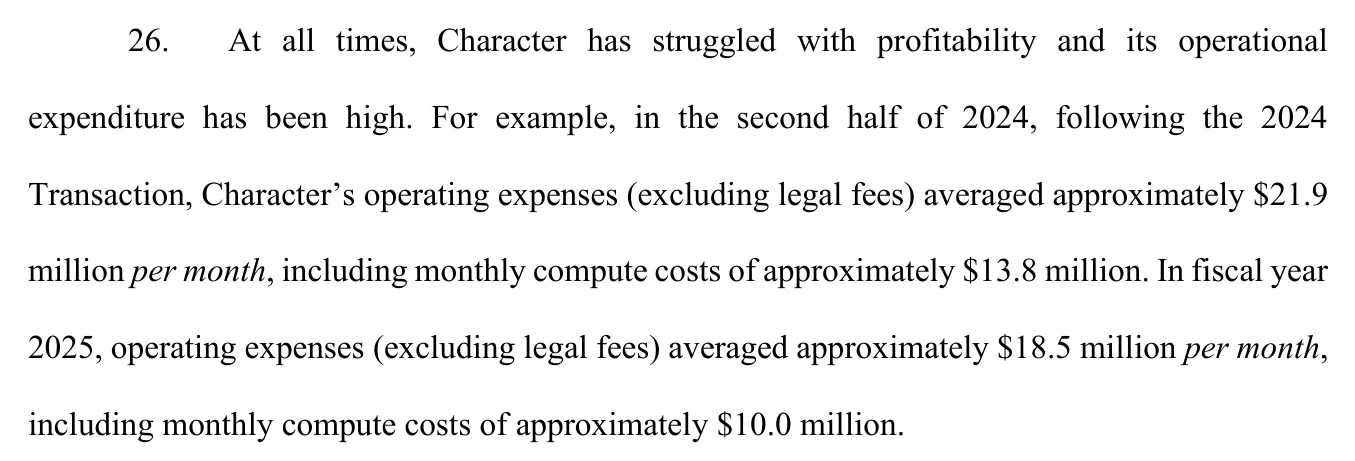
The second reason is high operating costs (the everyday cost of running the company), which is why it needed outside money.
Character.ai per month, US$ millions (costs exclude legal fees)
The 2025 revenue bar is my own sum: $23.6 million for the year, divided by twelve. By the same sum, against about $222 million of operating costs (twelve months at $18.5 million), revenue covered about 11 cents of each dollar in fiscal 2025. These costs leave out legal fees, so the real gap was wider. So where did the money go?
Why does each free chat cost an AI app money?
Because each reply is worked out fresh, on expensive chips. A large language model (LLM) writes each message on GPUs, specialist chips whose capacity Character.ai contracted from cloud providers, so more chatting needs more chips. That computing ("compute") cost about $56.1 million in the first eight months of 2026, about 45% of operating costs (CEO declaration, 2026).
An analogy: picture a restaurant with unlimited free refills, where each refill costs the kitchen money. A regular who stays all afternoon fills the room, but only pays off if what they buy covers the refills. Character.ai's 2023 paid-plan launch put both of these lines in one post.

We are proud to continue offering free and unlimited messaging for ALL users. [...] conversations have a significant cost
Character.ai Announcing c.ai+, May 2023
Its help center still says "Unlimited messaging stays on every plan, including free" on a September 2026 page (Character.ai help center). A c.ai+ plan costs $9.99 a month at the standard US rate (Character.ai help center).
Free users get basic chat styles, a slow mode and ads, while paid plans add premium styles and fewer or no ads. But the number of free messages, which drives the computing bill, stayed uncapped.
Here is the twist. A typical web app is like a printed menu, where one more copy costs very little. An AI reply is a dish cooked to order, so I read those 120 minutes a day as a cost, not only a win. Each extra hour of free chat earns back only what ads and in-app purchases bring. So who was paying?
Were the users ever the buyers?
Some were, but most of the revenue came late. Subscription revenue grew from about $0.6 million a month in January 2024 to $2.8 million in August 2026. Ads started in mid-2025 and reached about $2.5 million a month (CEO declaration, 2026). Ads also add a second buyer, the advertiser, who cares what its ads appear next to.
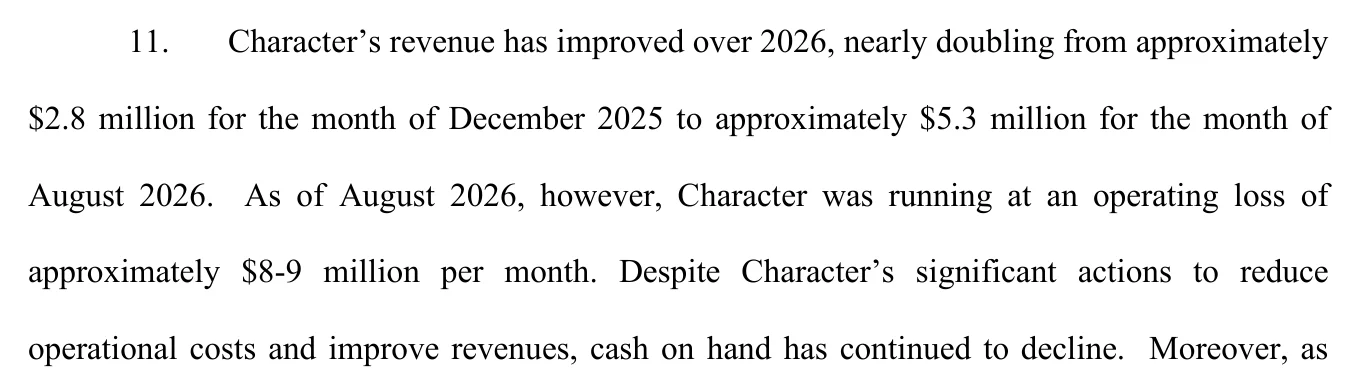
Revenue nearly doubling in eight months is real progress, and costs fell by more than a third since late 2024. It was still losing $8-9 million a month, and one number shows the gap plainly.
What does this mean for your GTM strategy?
When each use costs you money, a big free user count is a bill until someone pays for it. Here is the number: in August, each monthly user brought in roughly 44 cents of revenue against about $1.11 of operating cost, before legal fees. (My own sum: $5.3 million and $13.3 million, each divided by about 12 million users.)
If a pitch that leads with user count has ever made you uneasy, this is why: users measure attention, and buyers measure the business. Decide the buyer and the price first, because growth without them makes the loss bigger.
- Name who pays, separately from who uses. A user, a subscriber and an advertiser are three different buyers with three different reasons to say yes.
- Price the expensive thing. If messages, images or minutes drive your computing bill, cap that on the free plan, then sell more of it on the paid plan.
I cannot say a usage cap would have saved Character.ai, since its own filing blames the legal overhang for the failed fundraising. My point is narrower: a product that pays its own serving costs needs far less outside money, so it has more room when trouble comes.
Run it this week
- Write two lines: who uses the product, and who pays. If they differ, write down why the payer says yes.
- Work out cost and revenue per active user per month: computing, support and storage, then revenue, each divided by monthly active users.
- Find your most expensive free action and decide whether to cap it, price it or move it to the paid plan.
- List your 20 heaviest users and check how many of them pay.
Questions people ask
Why did Character AI file for bankruptcy?
Its CEO's court statement names high operating costs, led by computing, and failed fundraising, because buyers and investors saw "the litigation and regulatory overhang" as too great.
Is Character AI shutting down?
Not yet. The company says the app is still running during the court-supervised sale, and the Disney deal's milestones need the sale closed by 17 December 2026. If no bid keeps it going, the company says it will be wound down.
How does Character AI make money?
Mainly from c.ai+ subscriptions ($9.99 a month at the standard US rate) and in-app ads, with in-app purchases added in early 2026.
Does Character AI make a profit?
No. Its CEO's declaration says "at all times, Character has struggled with profitability", and in August 2026 it was losing about $8-9 million a month.
Got this by email? Hit reply: which free feature of yours do you suspect costs more than it earns?
Harshil
Sources
- Character.ai blog, 2026 blog.character.ai
- CEO declaration, 2026 cases.stretto.com
- Character.ai blog, 2023 blog.character.ai
- Voluntary petition, Doc 1 cases.stretto.com
- Character.ai help center support.character.ai
- Character.ai help center support.character.ai