GTM Engine · · 6 min read
GTM strategy for Meta ads in 2026: why 150 ads can look like a few
 By Harshil Jani
A go-to-market (GTM) strategy for Meta ads in 2026 starts from one change: Meta now finds your buyers mostly from your ad creative, not from the targeting you set. So each ad is a test of one message for one kind of buyer, and Meta's Andromeda system treats ads that look alike as the same ad.
In this article
- Where Meta ads sit in a GTM strategy, and what changed in 2026.
- A popular reel's method for making 150 to 750 ads a week, and what Meta itself says about it.
- What to make instead, so each ad you pay for teaches you something about your buyer.
Where do Meta ads fit in a GTM strategy?
Ads are a channel, and a channel comes after you know who you sell to and why they should pick you. In the order I use for go-to-market, the buyer and the positioning are decided first, then the price, and only then one channel to learn from (what go-to-market actually is). Paid ads are useful at that channel step for one reason: they are the fastest way to find out which message makes which buyer stop and act.
What changed is how Meta finds that buyer. Meta wrote in April 2025 that "the focus has shifted from niche targeting to creative diversification as the best lever to find the most relevant audiences" (Meta for Business, 2025). You pick the audience less than you used to and the ad picks it more, because Meta shows each ad to the people it predicts will respond.
That turns your ad creative into a GTM decision. Each ad is a small bet on one buyer and one message, so the real question for a Meta ads strategy is how many genuinely different bets you are placing, which is where a popular reel and Meta's own documents disagree.
What does the reel say?
A reel on Alex Hormozi's Instagram, posted on 4 October 2026 and presented by an unnamed person in an Acquisition.com shirt (Instagram), breaks an ad into three pieces: the hook (the first few seconds that stop the scroll), the meat (the middle, which explains the product or problem) and the CTA (the ending that tells people what to do).
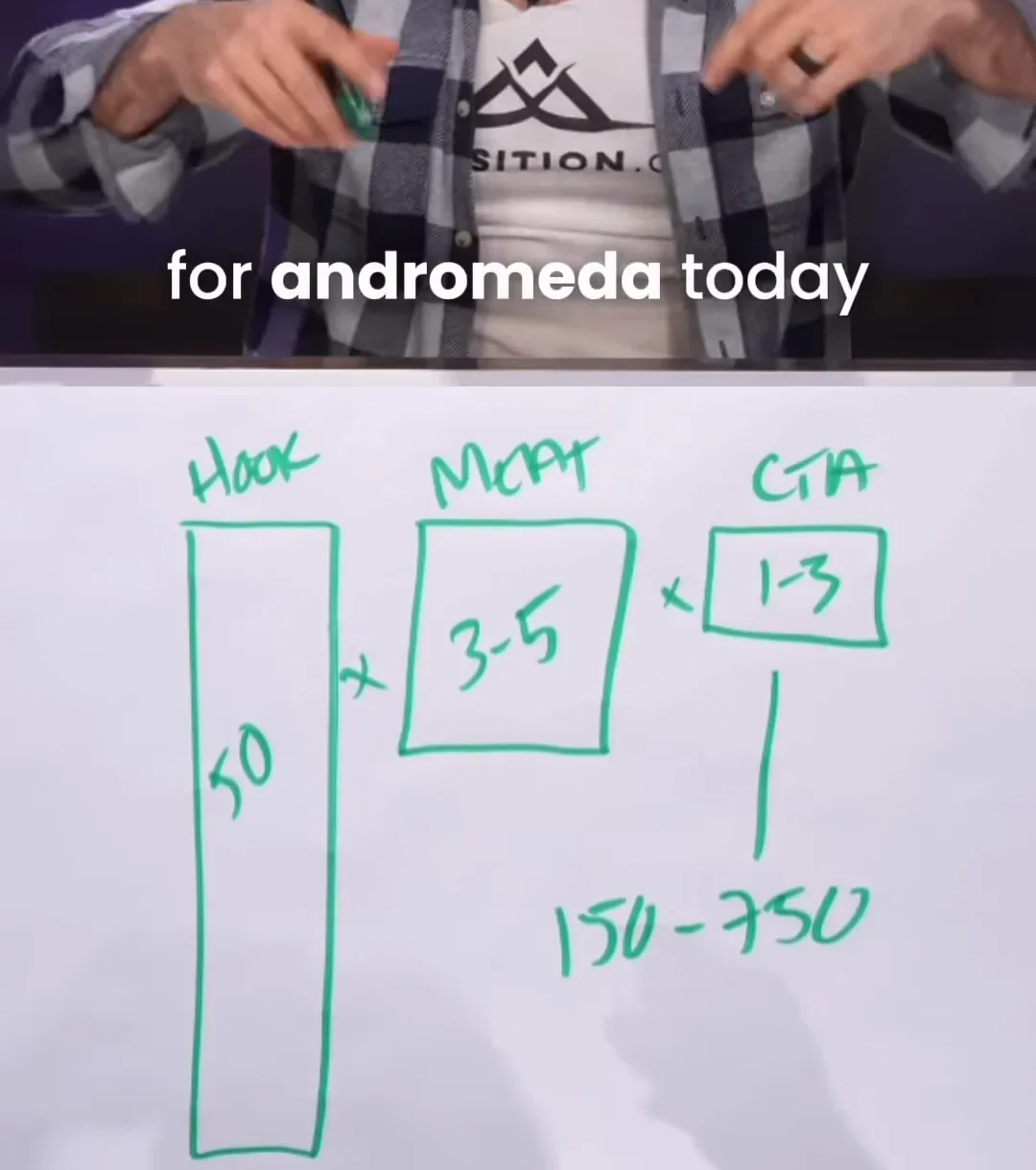
The idea is to film 50 hooks, three to five middles and one to three endings in one session, then mix and match them. Fifty hooks times three middles times one ending is 150 ads, and at the top end it is 750, which the reel says is "huge for Andromeda today, variety".
Most of the reel is useful advice, especially on where to find hooks and how to write a clear ending. My disagreement is with one word, "variety", because Meta has said in writing what it counts as different, and mixing pieces from one shoot mostly is not it.
What is Meta Andromeda, in simple terms?
Think of Andromeda as a first filter. When someone opens Instagram or Facebook, there are tens of millions of ads that could be shown, and Andromeda quickly shortlists a few thousand, after which other models pick the final ones (Meta Engineering, 2024).
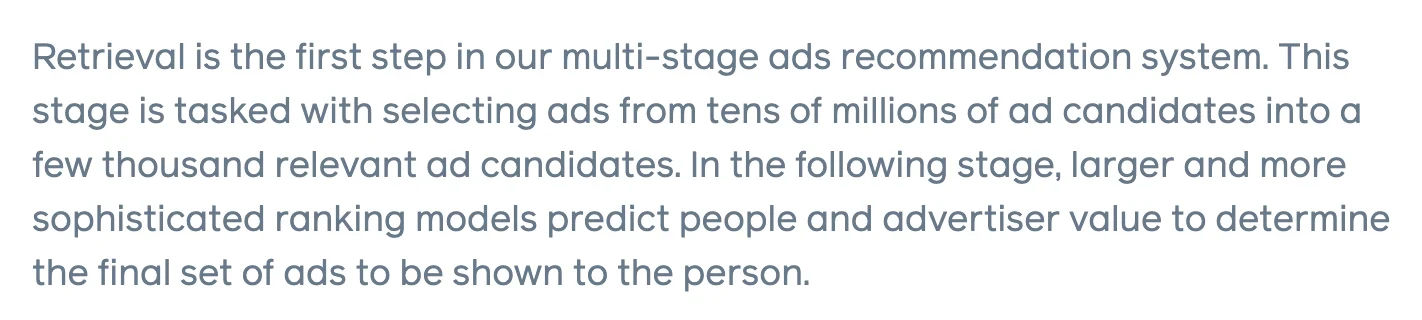
Meta built it to cope with a flood of new ads, many of them made with AI tools, and since then Meta has been telling advertisers to give it more ads that are genuinely different from each other.
Does Meta count 150 mixed ads as 150 ads?
Not if they look alike. Meta wrote in December 2025 that its system "groups together ads that share key visual and thematic attributes", and that ads which "look or feel alike" are "seen as variations of the same creative" (Meta for Business, 2025).
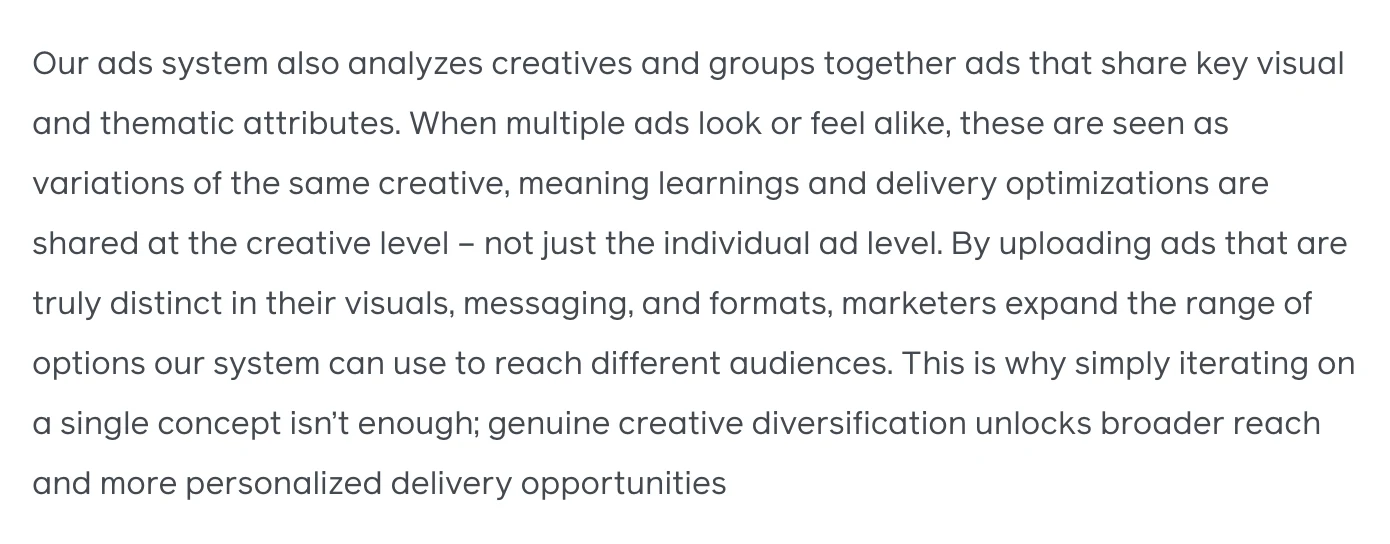
Meta even gives an example of what does not count as different: "two ads with identical visuals, but different text CTAs". Changing only the ending is close to that example. Meta has not said anything specific about changing only the hook, so this part is my reading: if 50 hooks are filmed in the same room, by the same person, in the same shirt, Meta may well see them as one ad too. That matters because you would pay to film and edit 150 ads but get the learning of only a handful,.
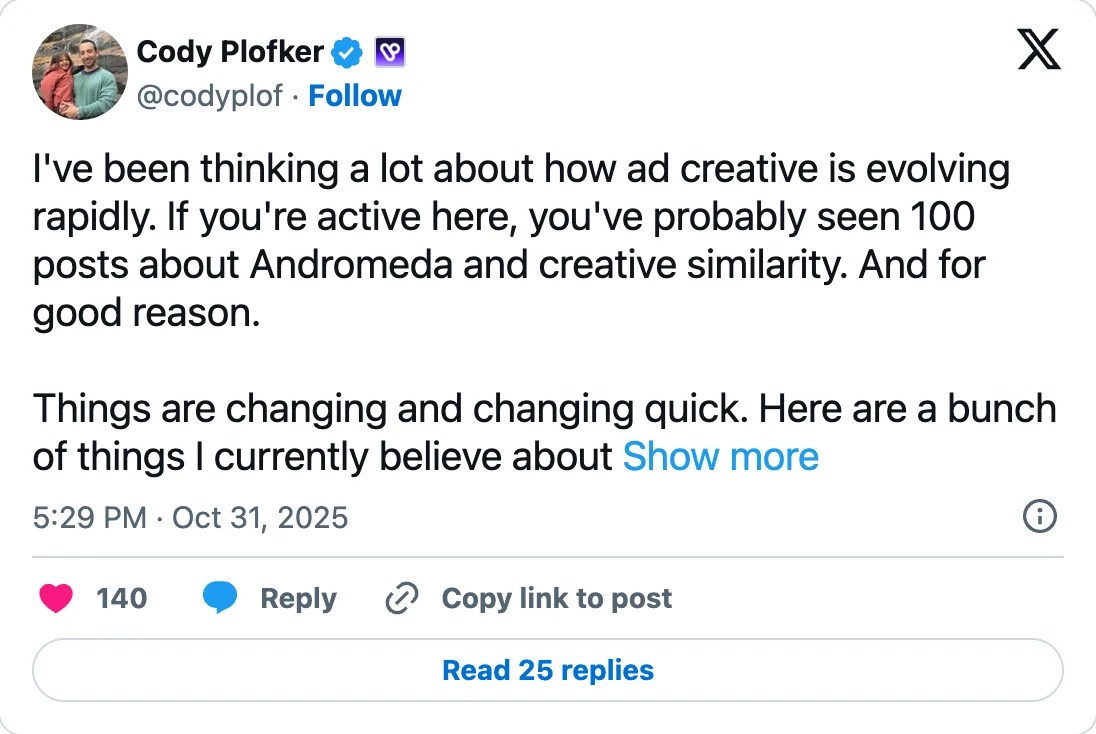
One advertiser says the same thing from experience. In an X post, Cody Plofker wrote that ads he thought "looked very different" were treated as the same ad, so "small variations like hooks, copy, etc seem mostly pointless" (X, 2025).
Can you even run 750 ads?
Usually not at the same time. Meta caps one ad set (a group of ads sharing a budget and audience) at 50 ads, and a smaller advertiser's Page can have 250 ads live at once. Meta also warns that "too many ads can result in worse performance", because each ad gets too little budget to learn from (Meta Business Help).
| Meta's rule | The limit | Source |
|---|---|---|
| Ads in one ad set | 50 | Meta developer docs |
| Live ads for a Page spending under USD 100K in its biggest month | 250 | Meta Business Help |
| Meta's advice | "Decrease ads per ad set, but maintain diverse creative assets per ad set" | Meta Business Help |
So the 150 to 750 ads are best treated as a pile to choose from, not a list to launch.
What should you make instead?
Make a few ads that are different in idea, not many that differ in a detail. Meta's own advice is to make ads "truly different in look, feel, storyline, and message" (Meta for Business, 2025), and the reel already lists the ingredients: different formats (a demo, a customer story, a how-to, a video with no face) and different audiences.
You keep the reel's hard work, writing lots of hooks, but you use it to pick the best two or three hooks for each idea instead of filming every combination.
What does this mean for your GTM strategy?
Five different ads are five positioning tests; 150 lookalike ads are mostly one. When one idea wins, say the customer story aimed at operations leads, you have learned which buyer responds and to which message, and that answer belongs everywhere else in your go-to-market: the homepage headline, the sales deck and the first line of your outbound emails.
So I would judge a Meta ads strategy less by how many ads it ships and more by how many clear answers it brings back about the buyer. The reel's volume of writing is a good habit; the GTM job is to turn that volume into a handful of distinct bets you can read.
Run it this week
- Write 50 hooks. It is cheap research, and the reel's tip to look at your own best posts and at other brands' long-running ads is a good start.
- Sort them into five ideas, each one a different format or aimed at a different kind of buyer.
- Film each idea differently: another place, another person or another style, so the ads do not look alike.
- Launch five ads, not 150, each with its best two or three hooks.
- Check Meta's creative diversity label for the ad set, and if it says low, swap out the idea that looks most like another one (Meta says this label is "estimated and in development").
Questions people ask
What is a GTM strategy for Meta ads?
It is the plan for which buyers you want to reach on Facebook and Instagram, what message each one gets, and how you will read the results. Since Meta now finds audiences mostly from the creative, the plan comes down to making a few clearly different ads, one per buyer and message.
What is the Meta Andromeda update?
It is the first filter in Meta's ad system, announced in December 2024, which shortlists a few thousand ads out of tens of millions before other models make the final pick (Meta Engineering, 2024).
Is Andromeda the whole Meta ads algorithm?
No. It only does the shortlisting, and Meta says other models such as GEM then "choose and rank the ads most likely to resonate with each person" (Meta for Business, 2025).
How many ads can I put in one Meta ad set?
Up to 50, and Meta advises fewer ads per ad set with more variety inside them (Meta Business Help).
Does changing the hook or the ending make a new ad for Meta?
Changing only the ending is close to Meta's own example of an ad that is not really new. Meta has not published a rule for hooks, so assume hooks filmed in the same setup may be grouped together.
Harshil
Sources
- Meta for Business, 2025 facebook.com
- Instagram instagram.com
- Meta Engineering, 2024 engineering.fb.com
- Meta for Business, 2025 facebook.com
- X, 2025 x.com
- Meta Business Help facebook.com
- Meta developer docs developers.facebook.com
- Meta Business Help facebook.com