GTM Engine · · 6 min read
GTM strategy for startups: the first 90 days for a technical founder
 By Harshil Jani
What is the one GTM job a technical founder cannot hand to ads, a sales hire or an AI agent? A GTM strategy for startups decides who you sell to, why they buy, what they pay and where you find them. In the first 90 days, a technical founder tests it by hand, one sale at a time.

In this article
- What Dropbox learned when it tried to buy growth with ads.
- A week-by-week 90-day checklist you can copy into your notes today.
- When to hire sales or switch on AI, and why not sooner.
What is a GTM strategy for startups?
It is the six decisions a large company makes too, made with almost no data. In the order I use (buyer, positioning, price, channel, sales motion, measure), a startup's job in its first 90 days is to get real answers to the first five, so the sixth has something to measure (what go-to-market actually is).
The technical founder's instinct runs the other way: build it well, launch it loudly, buy some ads, then hire someone to sell. That plan feels reasonable because it keeps you at the keyboard. Dropbox's own plan, on a slide Drew Houston later showed, read "Big launch at TechCrunch50 / Buy some AdWords / Hire, um, a PR firm, or a VP of Marketing". The result is on a slide too.
What happened when Dropbox tried to buy growth?
It paid more for each customer than the product cost. In his 2010 "Startup Lessons Learned" slides, Drew Houston describes hiring an "experienced SEM & affiliate marketing guy", picking keywords, building landing pages and going live in early 2009 (Drew Houston, 2010). SEM means search engine marketing, the paid ads beside search results, and affiliate marketing pays other sites for each signup they send.
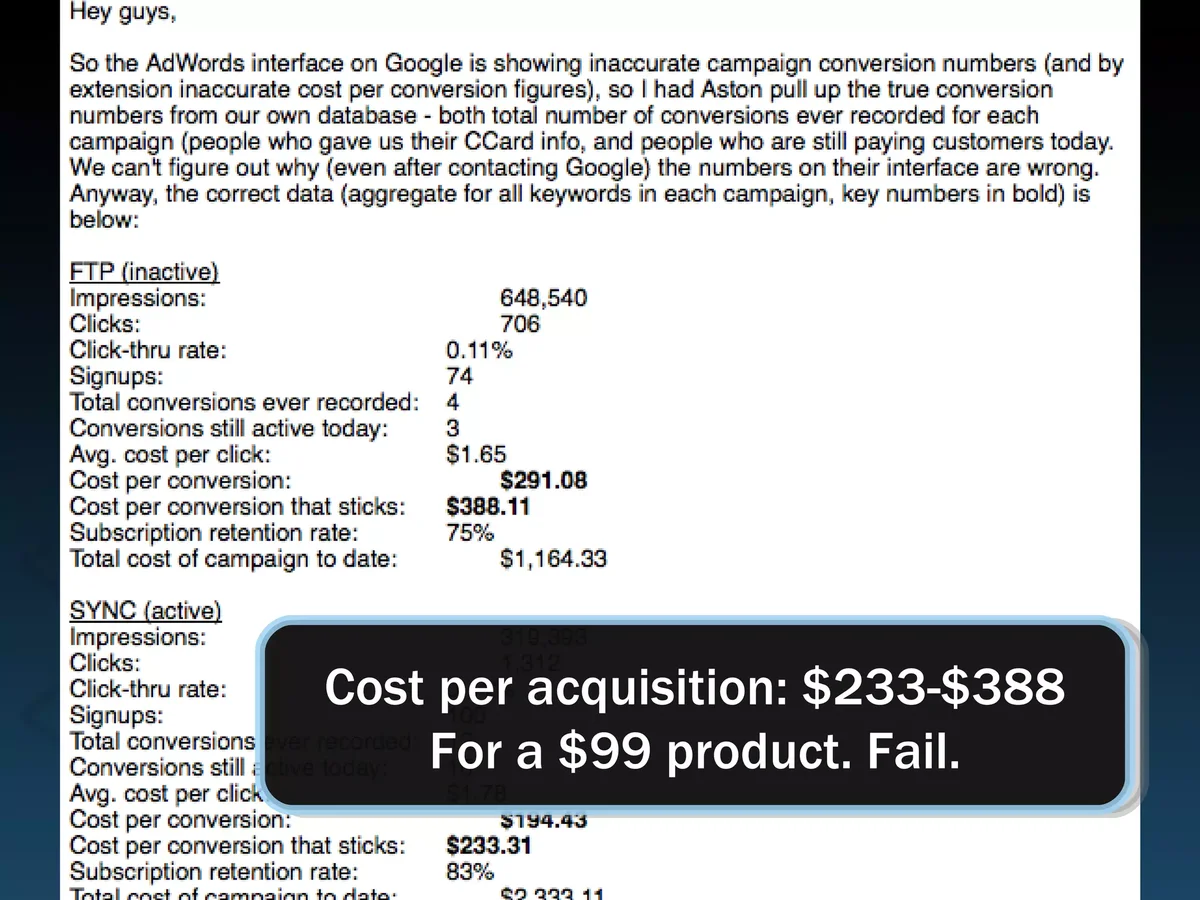
The ads were not what had worked for Dropbox. The same deck says its minimum viable product (the smallest version that tests the idea) was a three-minute screencast posted to Hacker News in April 2007, and that a later beta video drew 12,000 votes on Digg and took the waiting list "from 5,000 to 75,000 in one day" in March 2008. Both times the makers showed the product themselves, in places their early users already gathered. Houston's own diagnosis is the line I would hand a technical founder first.

Search is a way to harvest demand, not create it.
Drew Houston Co-founder and CEO, Dropbox
His slide explains why: "people weren't actively looking for what we were making." If people are not yet searching for what you make, there is little demand to harvest, so the first 90 days are about creating it, and in Dropbox's case the demand came from the makers showing the product where early users already were.
Why do technical founders avoid selling?
Because code is comfortable and strangers say no. Paul Graham, co-founder of Y Combinator, named it plainly in 2013 (Paul Graham, 2013).

They'd rather sit at home writing code than go out and talk to a bunch of strangers and probably be rejected by most of them.
Paul Graham Co-founder, Y Combinator
In the same essay he writes that "at least one founder (usually the CEO) will have to spend a lot of time on sales and marketing", and he gives the examples: the Collisons setting Stripe up on a prospect's laptop on the spot, and the Airbnb founders going door to door in New York, where he says about 30 days with users "made the difference between success and failure."
What should the first 90 days look like?
Four blocks: find the buyer, sell it by hand, measure, decide. The checklist below is my synthesis of the sources in this article, not a published method, so treat the week numbers as a pace rather than a rule.
| When | Do this | Done when |
|---|---|---|
| Week 1 | Write one buyer sentence (role, company type, problem) and list 50 named people who fit | You can name 50 without guessing |
| Week 2 | Hold 10 problem interviews: ask about the last time the problem happened, not about your idea | 10 calls logged in their own words |
| Week 3 | Hold 10 more, then narrow to the group whose problem hurts most | One segment named, the rest parked |
| Week 4 | Write a two-line position and a price, and show both on calls | Pushback is about price, not the problem |
| Week 5 | Pick one channel where your list already gathers | One channel and one number written down |
| Week 6 | Run each demo yourself and set accounts up on the call | First 3 users, set up by you |
| Week 7 | Keep selling and log each objection word for word | An objection list with counts |
| Week 8 | Fix the top objection in the product or the pitch, not with a discount | It stops coming up |
| Week 9 | Track weekly growth in revenue, or active users if you do not charge yet | One chart, updated each Monday |
| Week 10 | Ask each paying user to introduce one peer | Referral calls booked |
| Week 11 | Ask active users the "very disappointed" question (results firm up near 40 replies) | Score and reply count recorded by segment |
| Week 12 | Write the playbook: buyer, message, objections, how a yes happens | Someone else could follow it |
| Week 13 | Decide to keep, narrow or change the buyer, and only then hire or automate | Decision written down with the numbers |
How do you know it is working by day 90?
Pick one or two numbers and check them weekly. Y Combinator's Geoff Ralston tells founders to choose "the one or two key metrics" early and to prefer depth of pain over breadth of interest (Geoff Ralston, Y Combinator, 2017).

Recruiting 10 customers who have a burning problem is much better than 1000 customers who have a passing annoyance.
Geoff Ralston Partner, Y Combinator (2017)
For the number itself, Graham wrote in 2012 that "a good growth rate during YC is 5-7% a week", measured in revenue, or active users if you do not charge yet, and that if you can only manage 1%, "it's a sign you haven't yet figured out what you're doing" (Paul Graham, 2012). Small weekly gaps compound into very different years.
What a weekly growth rate becomes in a year
The second check is Sean Ellis's survey question, which Superhuman ran as "How would you feel if you could no longer use Superhuman?" After benchmarking nearly a hundred startups, Ellis set the bar at 40% of users answering "very disappointed" (Rahul Vohra, First Round Review, 2018). Superhuman's founder, Rahul Vohra, says the score turns "directionally correct" once about 40 people have answered, so with a handful of early users, read the score as a hint rather than a verdict.
When should you hire sales or switch on AI?
After you have closed the first customers yourself. SaaStr's founder and CEO, Jason Lemkin, puts this first in his list of ten mistakes founders make when hiring their first sales team (SaaStr, 2020).
You can't hire any sales reps before you've done it yourself.
Jason Lemkin Founder, SaaStr
He puts the bar at "those first 10, 20, 30 customers", and he applies the same logic to AI: an AI SDR (software that does a sales development rep's job of finding and emailing prospects) fed a playbook that does not convert "will just execute that bad playbook at infinite scale" (SaaStr, 2026).
What does this mean for your GTM strategy?
The job you cannot hand off is writing the spec for your sales motion, the repeatable steps that turn a stranger into a paying customer, and for now you are the one person placed to write it. A hire, an ad budget and an AI agent all scale a process, and in week one you do not have a process, only a guess about a buyer.
An analogy for engineers: you would not write a deploy script for a deploy you have not yet run by hand, because you do not yet know which step breaks, and selling works the same way: run it manually until you know where it breaks, write it down in week 12, and the playbook becomes the requirements doc for each hire and tool after it. Houston's slide is the reason: ads harvest demand, and in your first 90 days the demand has to be created by you.
Run it this week
- Write your buyer sentence and list 50 real people who fit it.
- Book five problem interviews and ask each about the last time the problem cost them something.
- Pick your one number for the next 90 days and put it on a chart you will update each Monday.
- Hold off on anything that scales an unproven motion: ads, an automated cold-email tool, a sales hire.
Questions people ask
What is GTM for startups?
GTM, short for go-to-market, is a startup's plan for who it sells to, why they buy, what they pay, where it finds them and how deals close. Early on it is tested by the founders in person rather than run by a team.
What does founder-led sales mean?
It means a founder personally finds, pitches and closes the first customers. Jason Lemkin of SaaStr argues founders need "those first 10, 20, 30 customers" before hiring a sales rep.
How do you do founder-led sales?
Pick one narrow buyer, interview them about the problem, run each demo yourself and set new users up on the spot, the way Paul Graham describes the Collisons doing for Stripe. Log each objection and fix the one you hear most.
When should you move on from founder-led sales?
When someone else could follow your written playbook and win deals with it. Lemkin's bar is the first 10 to 30 customers closed by founders, and he says that when founders skip that step, the reps "close zero".
Got this by email? Hit reply: what is the one part of selling you keep putting off by writing more code?
Harshil
Sources
- Drew Houston, 2010 slideshare.net
- Paul Graham, 2013 paulgraham.com
- Geoff Ralston, Y Combinator, 2017 ycombinator.com
- Paul Graham, 2012 paulgraham.com
- Rahul Vohra, First Round Review, 2018 review.firstround.com
- SaaStr, 2020 saastr.com
- SaaStr, 2026 saastr.com