GTM Engine · · 5 min read
What is taste in AI, and is it really the new moat?
 By Harshil Jani
Why would OpenAI's president call taste "a new core skill"? Taste in AI is the judgment to decide what is worth making and to tell great output from merely plausible output. AI made producing text, code and designs cheap, so choosing what to make, and what to refuse to ship, is the scarce skill that sets work apart.

In this article
- What taste actually means, in plain words, and where the idea came from.
- Why AI makes it matter more, and the research that explains it.
- Where the "taste is the moat" idea breaks, and what to do about it.
What is taste in AI?
Taste is the standard you hold work to; skill is the ability to meet it. Paul Graham wrote the cleanest version in his 2002 essay (Taste for Makers).
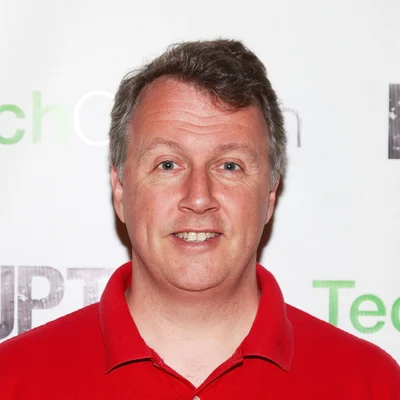
The recipe for great work is: very exacting taste, plus the ability to gratify it.
Paul Graham Co-founder, Y Combinator
Read that recipe again with AI in mind. "The ability to gratify it" used to be the expensive half: years of learning to code, design or write. Models now do a passable version in seconds, so the exacting half is the part that still separates people. That shift is the whole debate, and the idea behind it is older than ChatGPT.
Where did Silicon Valley's obsession with taste start?
With Steve Jobs, insulting Microsoft on PBS. In the 1996 documentary Triumph of the Nerds, he said he had no problem with Microsoft's success. His complaint was its taste.
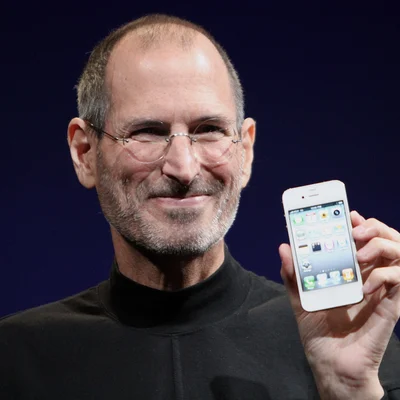
The only problem with Microsoft is they just have no taste, they have absolutely no taste.
Steve Jobs Co-founder, Apple
He explained it in the same breath: "they don't think of original ideas and they don't bring much culture into their product." So for Jobs, taste was a point of view, not good looks (PBS transcript, 1996).
Why are AI leaders talking about taste now?
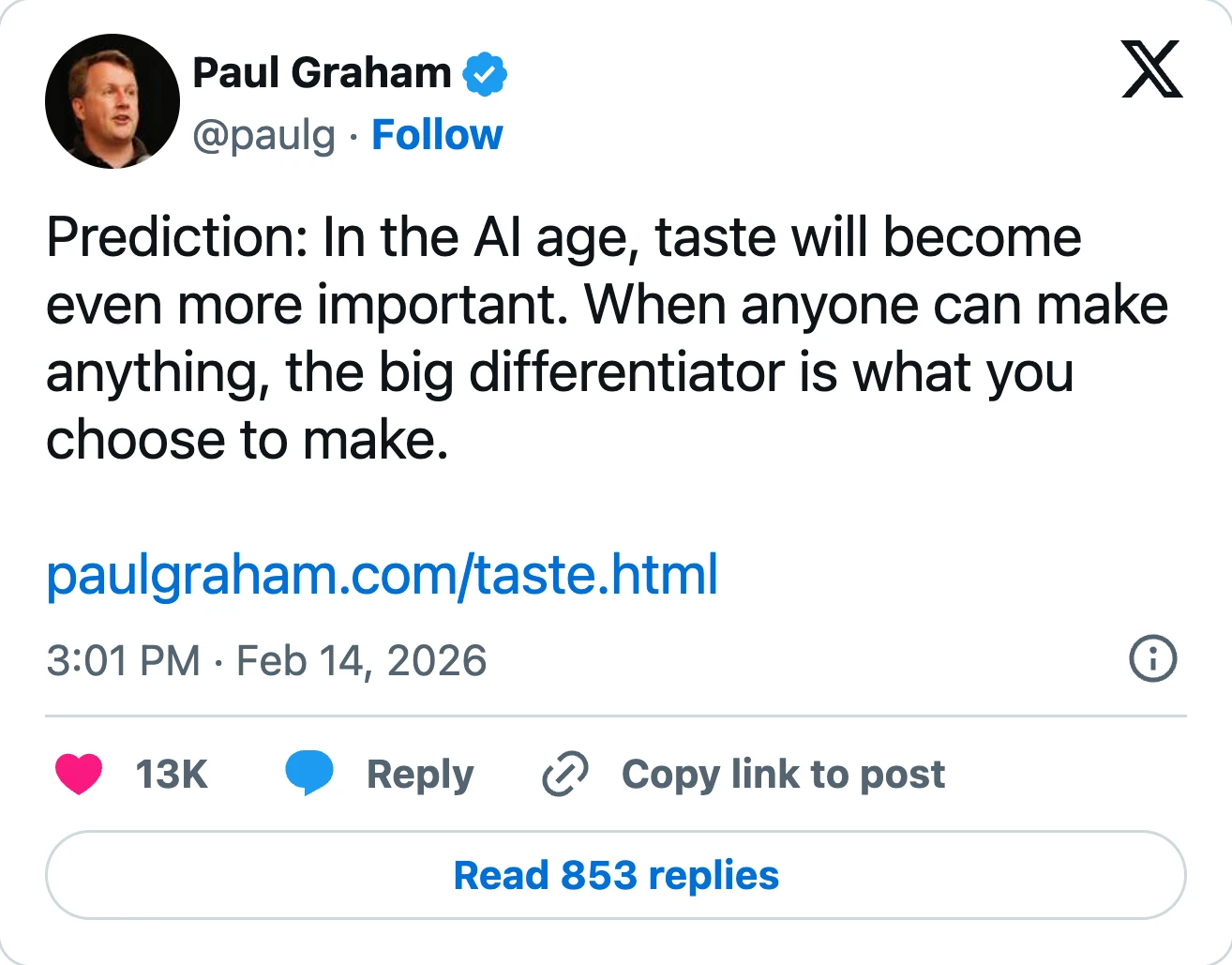
Because in one week of February 2026, the people who fund and build AI said it out loud. Paul Graham posted a prediction on 14 February, and OpenAI's president followed two days later with six words that drew more than 10,000 likes on X.
| Who | When | What they said | What they meant |
|---|---|---|---|
| Garry Tan, Y Combinator | Jan 2025 | "Agency is prompting and taste is evals" (X) | Taste is the test you run on AI output |
| Paul Graham | 14 Feb 2026 | "the big differentiator is what you choose to make" (X) | Taste is choosing |
| Greg Brockman, OpenAI | 16 Feb 2026 | "taste is a new core skill" (X) | Taste is now a job skill |
| Olivia Moore, a16z | 25 Feb 2026 | "the returns to taste and point of view have gone way up" (a16z) | Taste earns more as making gets cheaper |
| Dylan Field, Figma | 15 Oct 2026 | "I believe design is actually how you win" (The Telegraph) | Design is the product edge |
Five people, one message: when making is cheap, choosing is the job.
Why does AI make taste matter more?
You might expect a machine trained on everything to have the best taste of all. The research points the other way: its answers drift toward sameness. A NeurIPS 2025 paper built a set of about 26,000 real open-ended questions, tested language models on them and found what its authors call an "Artificial Hivemind" (Jiang et al., 2025).
26,000
real open-ended questions in the study's dataset; models repeated themselves, and different models gave "strikingly similar outputs"
That finding covers open-ended tasks like brainstorming, not all work, but it goes a long way to explain the trend. If many teams ask similar models for a landing page, a tagline or a feature list, they tend to get similar answers, so the average becomes free and the distance from the average becomes the product. An analogy: AI is a kitchen that will cook anything you order, fast. It will suggest a menu too, but likely the same one it suggests to the restaurant next door.
Is taste really the new moat?
Partly, and the best critics explain where it stops. A moat is a lasting defence a competitor cannot cross. Shrivu Shankar argues taste does not last like that.
This is why I see taste as alpha, not a moat.
Shrivu Shankar Writer, blog.sshh.io
"Alpha" is an investing word for an edge over the market that shrinks as others catch up. His point: your judgment is only worth something relative to what AI does by default, and "that default resets every few months." Julie Zhuo adds that "great taste is more objective than we assume", so AI can compete on much of it (Julie Zhuo, 2025). Even she keeps one thing for people: at the top, taste is "also movement making", taking a risk on work that looks unfamiliar.
I think both critics are right about taste as polish. AI is getting better at nice fonts, clean layouts and tidy prose, release by release. Taste as a point of view is harder to copy, because it means picking a side, and the evidence above shows models drifting toward the same answers.
What does this mean for your GTM strategy?
Positioning is taste made public, and AI just made it the hardest step to fake. In my go-to-market order (buyer, positioning, price, channel, sales motion, measure), positioning is what you stand for and what you refuse to be (what go-to-market actually is). When you and your competitors use similar AI tools, the tidy, average homepage reads like theirs.
So treat taste the way Garry Tan framed it: as evals, meaning a written test you run on each output. Write down what "good" means for your product, in your words, including what you will not do, then hold each AI draft to it. That is the answer to the question at the top: OpenAI sells the making, and the making comes out much the same for you as for the next customer. Your written standard is the part a model cannot ship by default, and it is yours to keep only while you keep updating it.
Run it this week
- Write your taste in five lines: what your product, copy and design always do, and two things they never do.
- Collect ten examples you admire from outside your category and note what each one does that yours does not.
- Ask two AI tools to write your homepage headline and compare their versions with yours. If theirs sounds like yours, rewrite yours.
- Turn your five lines into a checklist and apply it to each AI draft before it ships.
Questions people ask
What is taste in AI?
It is the judgment to choose what is worth making and to tell great output from merely plausible output. AI made the making cheap, so as Paul Graham put it, "the big differentiator is what you choose to make."
Who said taste is a new core skill?
OpenAI president Greg Brockman, in a six-word X post on 16 February 2026, two days after Paul Graham predicted taste would matter more in the AI age.
What did Steve Jobs say about Microsoft having no taste?
In the 1996 PBS documentary Triumph of the Nerds, Jobs said Microsoft had "absolutely no taste", meaning "they don't think of original ideas and they don't bring much culture into their product."
Is taste the new moat?
Partly. a16z investor Olivia Moore says the returns to taste "have gone way up", but critics like Shrivu Shankar call it "alpha, not a moat": an edge that shrinks as AI's default output improves, so it has to be renewed.
Got this by email? Hit reply: what is one thing your product will never do, even if an AI suggests it?
Harshil
Sources
- Taste for Makers paulgraham.com
- PBS transcript, 1996 pbs.org
- X x.com
- X x.com
- X x.com
- a16z a16z.com
- The Telegraph t2online.in
- Jiang et al., 2025 arxiv.org
- Julie Zhuo, 2025 lg.substack.com