GTM Engine · · 6 min read
Y Combinator's go-to-market strategy: launch, then launch again
 By Harshil Jani
If YC tells founders to launch again and again, why does Hacker News, YC's forum for tech founders, give each YC startup only one Launch HN? Y Combinator's go-to-market strategy is many small launches instead of one big day: each launch goes to one crowd, carries something new, and tests who the buyer is and which message lands.

In this article
- Why YC calls the one big launch a myth, in its partners' own words.
- What Supabase, PostHog and Resend did after their first launch, with their numbers.
- The limit each launch channel sets, and what it means for your GTM plan.
What is Y Combinator's go-to-market strategy?
Launch early, then keep launching, and treat each launch as a test. In the GTM order I use (buyer, positioning, price, channel, sales motion, measure), a launch is a channel decision and a positioning test in one, because it puts your message in front of a specific crowd and shows you who reacts (what go-to-market actually is).
Most founders expect the opposite. YC's own library page for a 2024 partner video opens with the picture in their heads: "Launching a company is often pictured as a big splashy event with lots of media attention and hype" (Y Combinator, 2024). In the same video, Michael Seibel names that picture for what it is.
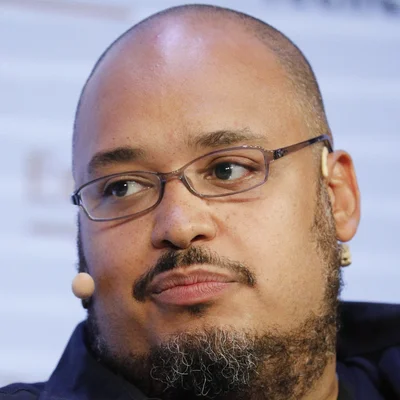
One of the most important pieces of pop culture knowledge is that your launch is important and that you only get one.
Michael Seibel Partner, Y Combinator (2024)
By "pop culture knowledge" he means, in his words, "knowledge that is false but widely believed". He adds that Airbnb "launched three times before anyone started to pay attention", learning something each time. Paul Graham, who co-founded YC, made the same point in 2013, describing founders who "seem to believe startups are projectiles rather than powered aircraft" (Paul Graham, 2013). One YC company planned the projectile launch anyway, and never got to fire it.
What happened to Supabase's planned big launch?
It never happened, because an early user posted Supabase on Hacker News first. Supabase, an open-source database company from YC's Summer 2020 batch (the group of startups funded together), planned exactly the launch most founders picture. Its CTO, Ant Wilson, describes the plan and how it fell apart (Supabase, 2021).
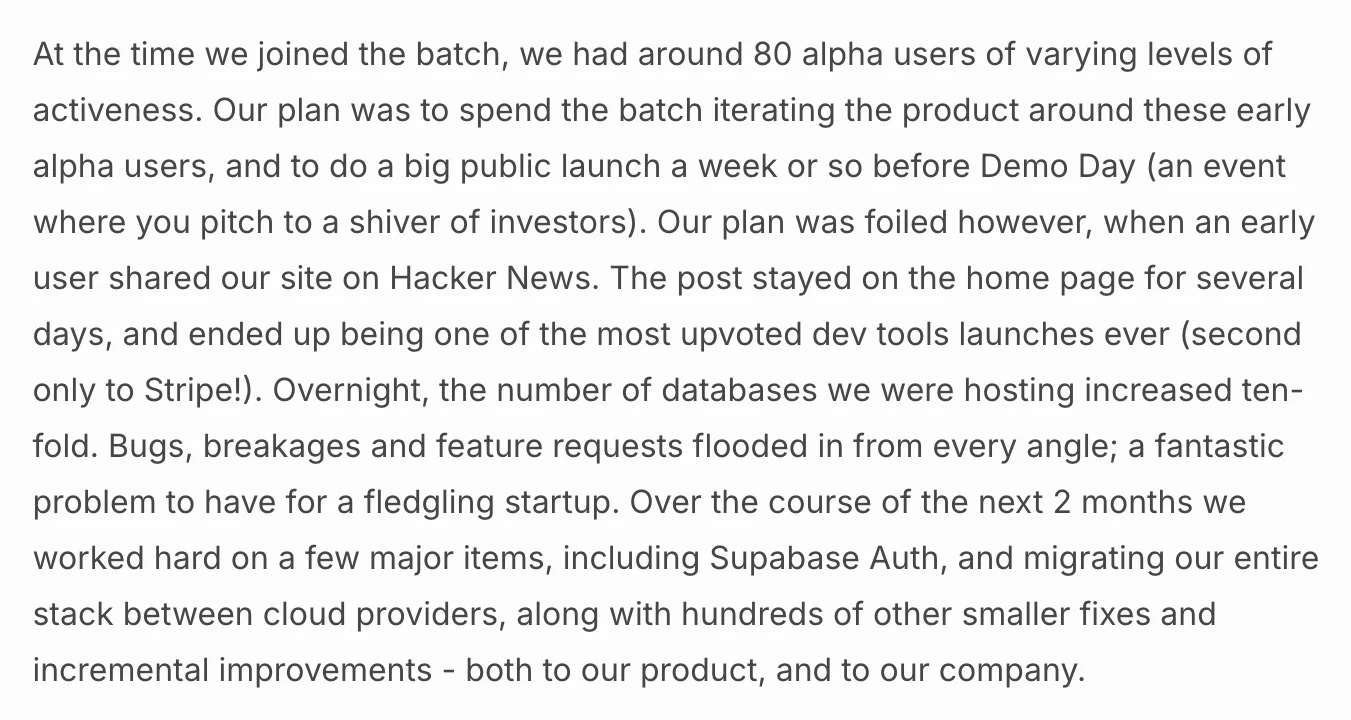
The "ten-fold" and "second only to Stripe" figures are Supabase's own, and I have not checked them independently. What matters is what the team did next: it announced its login feature, Auth, a few weeks before Demo Day (the day YC startups pitch investors), then asked "why just have one launch?" and turned Launch Day into Launch Week, shipping seven major features in the last week of March 2021. By July 2025 it was on Launch Week 15 (Supabase).
47%
Monthly growth in databases Supabase manages, sustained for 18 months to November 2021 (company-reported)
That figure counts databases, not revenue or paying customers, and Supabase credits launch weeks as "a key part" of the strategy behind it rather than the whole cause. So why does YC push founders toward more launches instead of one better one?
Why does YC say to launch again and again?
Because a launch few people notice costs little, and you still learn from it. As Seibel puts it in the same 2024 video, "if some small startup fumbles a launch, no one cares." Kat Mañalac, a YC partner who helps founders prepare their launches, titled her 2019 Startup School talk "How to Launch (Again and Again)" (Y Combinator, 2019).
I want to destroy the idea that launching is just one moment in time.
Kat Mañalac Partner, Y Combinator (2019)
Her reasoning is the GTM part. In another Startup School talk on YC's site she says that "launching on different channels will also help you determine whether you're even talking to the right users", because "different channels will naturally reach different audiences" (Y Combinator). So each launch is an experiment on the buyer and the message, and even a quiet one tells you something. She also tells founders to "plan a launch for every single community that you are part of."
What limits does each launch channel set?
Each channel limits repeats, and what it limits is newness. Hacker News, which Y Combinator "owns and funds" (HN FAQ), states its limit plainly for YC companies (Hacker News).

The other channels set the same kind of limit in different words:
| Channel | How often | What earns another go |
|---|---|---|
| Launch HN | Once per YC startup | Nothing, so pick the moment |
| Show HN | Again for real changes | "A major overhaul is probably ok"; feature updates "generally aren't" (HN) |
| HN repost | "A small number" | No significant attention "in the last year or so" (HN FAQ) |
| Product Hunt | Repeatable | "New significant product iterations" (Product Hunt) |
| Your own launch week | As often as you ship | A batch of real features |
So "launch again" does not mean posting the same thing to the same crowd. It means a new crowd, or something genuinely new for an old one.
How do YC companies launch again without repeating themselves?
They give each crowd a new reason to look. PostHog (YC Winter 2020) launched on Hacker News in 2020 with a narrow goal: "we wanted to find a group of people who loved it, as quickly as possible." Five days after the launch, its co-founder James Hawkins reported "well over 200 sign ups" and more than 800 GitHub stars (bookmarks developers give a project they like) (PostHog, 2020). Later, his posts about building the company "got us a couple more hits on the front page of Hacker News, which proved it worked, so we kept doing it" (PostHog, 2024).
Resend (YC Winter 2023) made the repeat a calendar. Its launch weeks ship "5 new features in 5 days", and after the fourth, in April 2025, the team scored the week on impressions (how often its launch posts were seen) and usage instead of revenue. The 45% below compares launch week 4 with launch week 3, as Resend reports it (Resend, 2025).

Currently, we've seen a 45% increase in impressions over the previous launch week.
Zeno Rocha Founder and CEO, Resend
Supabase's CTO explains why the repeat still reaches people: "you can launch a new feature many times over and always manage to reach people who either forgot, ignored, or just plain missed it the first few times."
What does this mean for your GTM strategy?
Attention is not the scarce thing in a launch; something new to say is. That answers the opening question. HN does not say why it allows one Launch HN, only to "play that card at the right time", but my read is that a company has only one first time, and each launch after it needs a new product, a major change or a new crowd. Your GTM plan is therefore a release calendar matched to a list of crowds, where each launch tests one thing: the buyer, the message or the channel.
An analogy: think of a comedian on tour. The same set works in each new city, but the home club only books them again when they have new material, and your crowds (communities, Show HN, Product Hunt, your own list) work the same way. YC's president, Garry Tan, closes the same partner video with the short version.

Launch early, launch often.
Garry Tan President and CEO, Y Combinator
Run it this week
- List five crowds you could launch to: communities you belong to, Show HN, Product Hunt, your email list, one niche forum.
- Pick one variable to test (the buyer or the one-line message) and write it down before you post.
- Launch to the smallest crowd first, ideally one where people already know you, and log who replies and what they ask.
- Put the next launch on the calendar and name the new thing it will carry; if you cannot name one, ship it first.
- Write the post by hand. HN's tips for Show HN posts now ask founders not to use an LLM for any of the text (Hacker News, Show HN tips).
Questions people ask
What is Y Combinator's go-to-market strategy for startups?
YC tells founders to launch early and keep launching, using each launch to find early adopters and test the message. Garry Tan sums it up as "launch early, launch often."
What is the difference between go-to-market and a product launch?
A launch is one event aimed at one audience. Go-to-market is the wider plan for buyer, positioning, price, channel, sales motion and measurement, and in YC's approach a series of launches is one way to test it.
Can you launch on Hacker News more than once?
A YC startup gets one Launch HN. A Show HN can come back for a major overhaul, and HN allows "a small number of reposts" of a story that has had no significant attention in the last year or so.
How often can you launch on Product Hunt?
Product Hunt's own guide says you can launch "as often as you have new significant product iterations available."
Got this by email? Hit reply: which crowd have you never launched to, and what is stopping you?
Harshil
Sources
- Y Combinator, 2024 ycombinator.com
- Paul Graham, 2013 paulgraham.com
- Supabase, 2021 supabase.com
- Supabase supabase.com
- Y Combinator, 2019 ycombinator.com
- Y Combinator ycombinator.com
- HN FAQ news.ycombinator.com
- Hacker News news.ycombinator.com
- HN news.ycombinator.com
- Product Hunt producthunt.com
- PostHog, 2020 posthog.com
- PostHog, 2024 newsletter.posthog.com
- Resend, 2025 resend.com
- Hacker News, Show HN tips news.ycombinator.com